
A Cleaner, Greener Kitchen

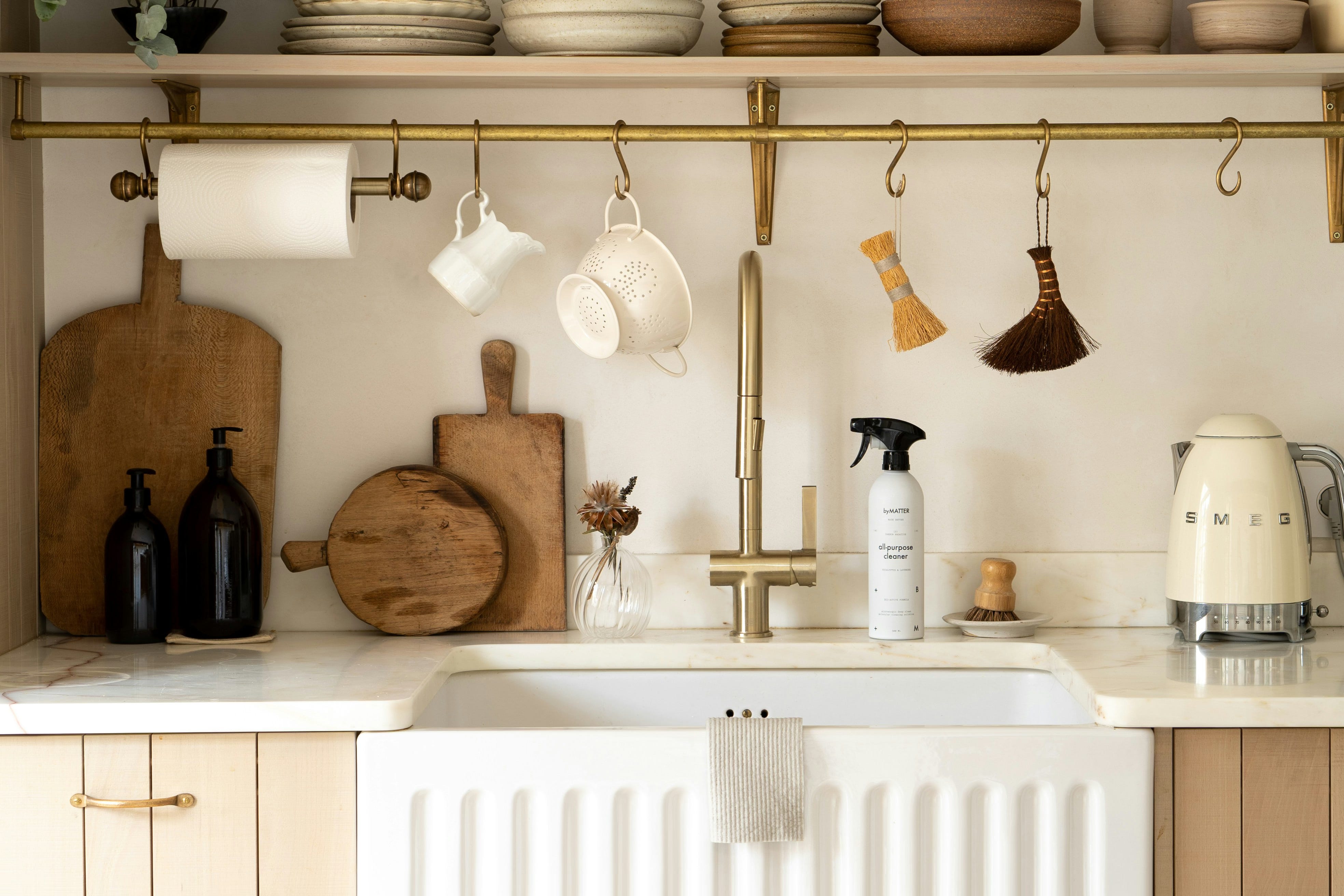
Photo by byMATTER MADE BETTER on Unsplash
Over the last few years, I’ve been trying out ways to reduce chemicals, toxins and pollutants in the home. I was keen to reduce the amount of landfill I produce, specifically from the kitchen and household cleaning and to try to eliminate the use of harmful chemicals and aerosolised toxins.
I am sometimes asked about the changes I have made over the last six years and below, you will find the swaps and discoveries I really rate.
Washing up
Ecologically friendly washing up liquid has been a great swap. I was reluctant, thinking it would not be as effective as Fairy, but I believe it really is. After a fortnight private cooking and doing all the washing up single handed, I was convinced to swap.
It works slightly differently to the traditional brands, but still works very effectively. I really notice how much more gentle it is to use, particularly as I have always found that Fairy wrecks the skin on my hands and nails very quickly, whereas Ecover does not damage my hands in the same way. I also like that it is non-toxic and in the summer months, I will use the grey water to put on the garden from the washing up bowl. The plants thrived and it felt like a good use of water.
I have given up plastic sponges and find a couple of good brushes (I put them in the dishwasher to clean if they’ve had a heavy scrubbing session), a copper scrubber and some loofah sponges work well and can be recycled or composted when they reach the end of their working lives.
I am working on a homemade dishwasher tablet option, but have not cracked it yet. At the moment, I use either Ecover dishwasher tablets or dishwasher soap nuts, which are available online and in health food shops. Again, I was sceptical, but they work really well, placed in the cutlery drawer or basket. As with many eco friendly options, one can often wonder if they will be effective and also the lack of smell is very noticeable, but I think these clean very thoroughly and can be composted once they’ve been used 2-3 times.
Microfibre cloths do work really well, but to reduce microplastics entering the waterways when they are washed, I am switching over to cotton. Cotton cloths work really well, but I think the tight weave cloths give a much better result. I use them for general cleaning around the house and, in many cases, just lightly dampened with some hot water for wiping down surfaces, stains and dusting.
A good tea towel is extremely useful, too, and the combination of cloths and tea towels really cuts down on the use of kitchen paper towels. I bulk buy tea towels from Samuel Lamont in Northern Ireland. Their Poli-Dri range are my favourite as they are really hard wearing, wash and dry brilliantly and work as an oven cloth if needed, too. I really think these are the best around and buy them in 20 packs for home delivery. They last for such a long time, too. And if you can’t give up kitchen paper towels, you might like to try Naked Paper.
General cleaning
A clean kitchen is crucially important to me. I have been inspected for years by the local council to be able to work from home and I am proud that I’ve always achieved a 5 Star (the highest) rating.
I have used Delphis cleaning products for a number of years and they are very effective. Ocado sell them, as do some health food shops and occasionally, some products are available in Waitrose.
I have found many recommendations from Nancy Birtwhistle absolutely invaluable. I make and use her Pure Magic and Basic Magic sprays to use for all-purpose cleaning and they work fantastically well. The Pure Magic spray is fantastic on sinks and bathrooms and the Basic Magic works very well for wiping down appliances. I bought some reusable glass spray bottles to fill with the solution and store any excess in reused Bold Bean jars. I also avoid sticky labels and have some marker pens which write directly onto glass. I now do this with preserves, too. Also, some really hot water with a dash of washing up liquid and a clean cloth works wonders. I really like that I am not spraying lots of scented chemicals around as I have become so much more sensitive to their smell since giving them up. I find this particularly noticeable in the kitchen, where fragrance can feel particularly out of place.
I won’t publish Nancy’s recipes here without permission, but they are available quite widely online and on her Instagram. They are easy to make and really work. I bulk bought citric acid and bicarb of soda online to use in larger quantities.
Cleaning the oven is always a bit of a chore, but I tried Nancy’s technique of putting a bowl of boiling water in a low oven to loosen any grease with the steam. Then rubbing bicarbonate of soda onto all the inside surfaces and this lifted grease very effectively and it felt much less harmful than the packs of oven cleaning gel I was buying. It really doesn’t take very long to do, either.
Nancy also has a trick to nestle oven shelves in a wheelbarrow of fresh grass clippings to release stuck on grease – it may sound a bit unusual, but it really works. Give the racks a good, hot, soapy wash afterwards.
Around the house, I have some great British-made brushes with bristles, feathers and wool for dusting and cleaning.
Cooking and storage
I have been busy seasoning pans recently as I try and give up non-stick. So many non-stick pans, even the really expensive ones, fail comparatively quickly, so I am determined to make the swap. I have some by Netherton Foundry, Lodge, Le Creuset Fissler and Zwillings on the go at present.
I am switching over to If You Care non-stick parchment paper for cooking instead of foil and Peace With The Wild cling film alternative is working well. It is compostable and made from PBAT and PBA.
Wherever possible, I don’t use plastic in conjunction with heat, and this applies to cooking equipment, too, such as mixing jugs and bowls, for example. I try and put warm food or liquids into glass, such as Pyrex, or ceramic for measuring and mixing and so on and when I do reheat using the microwave, I follow these principles.
I have found some good uses for beeswax covers and reusable plastic covers, but they are a bit hit and miss, so I wouldn’t necessarily recommend going out to invest in some, although I do find uses for them now that I have them. If you like the idea of beeswax covers, they are surprisingly easy to make from scratch by ironing a piece of fabric, sprinkling on some beeswax pellets and baking them for a couple of minutes until the wax melts. They’re ready to use when cool.
Aside from that, I make good use from the excellent Lakeland storage boxes, which work brilliantly, stack very well in the fridge or cupboards and don’t trigger a meltdown when trying to store them or find the appropriate lid to fit as they all fit together very neatly.
Another way to reduce plastics is to use hardwood chopping boards instead of plastic. They are an investment but a real pleasure to use. I bought some lovely ones from Sacha Whelan in Ireland and David Mellor in London.
I hope you may find some of these suggestions useful. And I’d love it if you have any recommendations you have discovered that you rate? Please leave me a comment, if so.